Singapore Wrote the World's First Rulebook for AI Agents. Here's What It Asks of Your Business
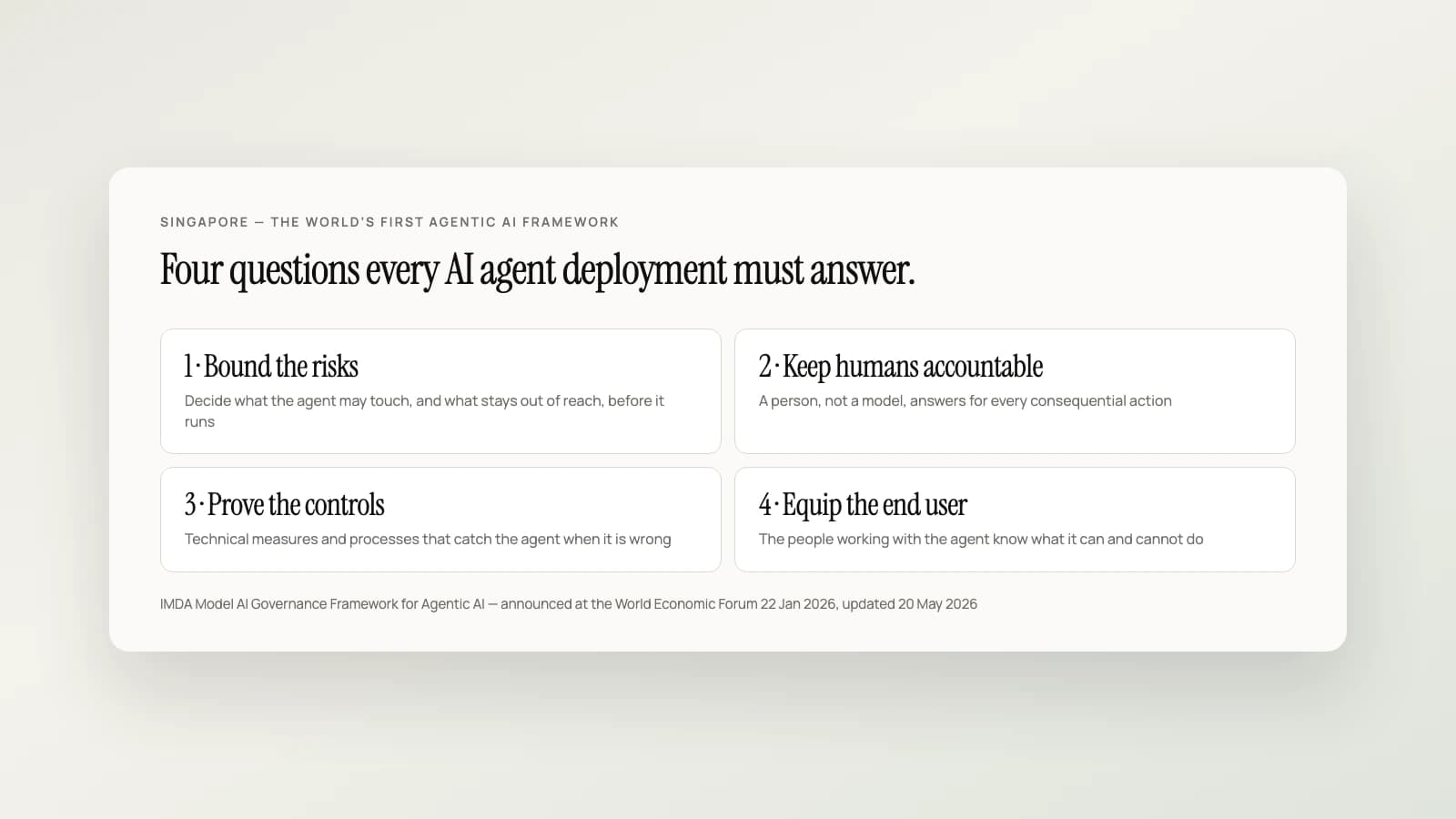
On January 22, 2026, at the World Economic Forum, Singapore announced something no other country had: a governance framework written specifically for agentic AI — systems that act, not just answer. IMDA updated it on May 20, 2026 with case studies from organisations already running multi-agent systems in production.
The framework is guidance, not statute. But it is the clearest available answer to a question every business deploying an agent eventually faces, usually after something goes wrong: who decided what this thing was allowed to do?
It is organised as four questions. If you run — or are about to run — an AI agent on real work, they are worth answering on one page before any regulator, client or insurer asks.
The four questions
- 1. Have you bounded the risks? Decide what the agent may touch and what stays out of reach — which systems, which data, which actions — before it runs, not after the first surprise.
- 2. Is a human meaningfully accountable? The framework is explicit that humans answer for agent behaviour. Meaningful accountability means someone reviews consequential actions, not that someone holds a title.
- 3. Do technical controls actually exist? Guardrails, logs, approval gates, and limits the agent cannot talk its way around — measures that catch the agent when it is wrong, because it sometimes will be.
- 4. Can the end user play their part? The people working with the agent know what it can do, what it cannot, and how to escalate when something looks off.
What answering them looks like in production
Abstract principles turn concrete the moment an agent handles money. In one of our production order-automation deployments, the agent runs behind 15 distinct anti-hallucination guardrails, and every consequential action — a payment confirmed, an order booked — waits for explicit approval. That is questions one through three answered in code rather than in a policy document.
The pattern generalises: bound the agent to one workflow, log everything it does, gate anything irreversible behind a person, and make numbers follow deterministic logic computed in code rather than generated by a model. None of this requires a compliance department. It requires deciding it before go-live.
The May 2026 update added something useful for buyers: real case studies of organisations operationalising the framework, including with third-party agents. The bar it implies for vendors is fair — if your AI provider cannot explain how their agent is bounded, logged and gated, that is your answer about the vendor, not about AI.
Why this matters beyond Singapore
Frameworks travel. Singapore's 2019 Model AI Governance Framework shaped how the region wrote its AI guidance, and the agentic edition is positioned the same way — it was launched at Davos, not at a local industry event, on purpose.
For a business in Jakarta or Kuala Lumpur, the practical read is this: the four questions are the likely shape of whatever your own regulator eventually writes, and they are already the shape of what enterprise clients ask in procurement. Answering them now is cheap. Retrofitting them after an incident is not.
Common questions
- What is the Model AI Governance Framework for Agentic AI?
- Singapore's IMDA guidance for deploying AI agents responsibly — the first national framework written specifically for agentic AI. It was announced at the World Economic Forum on January 22, 2026 and updated on May 20, 2026 with production case studies, including multi-agent and third-party agent scenarios.
- Is the IMDA agentic AI framework mandatory?
- No — it is guidance, not legislation. In practice it functions as the reference bar: enterprise procurement and regional regulators tend to borrow its structure, so meeting it early is cheaper than retrofitting it.
- What are the four dimensions of the framework?
- Assess and bound the risks; ensure meaningful human accountability; implement technical controls and processes; and enable end-user responsibility.
- Who is accountable when an AI agent makes a mistake?
- Under the framework, humans remain accountable — the deploying organisation decides what the agent may do and reviews consequential actions. That is why approval gates on irreversible steps are the single most important control.
- How do you bound an AI agent’s risk in practice?
- Limit it to one workflow, whitelist the systems and data it can touch, log every action, gate anything irreversible behind a person, and compute figures with deterministic logic rather than letting the model generate them. In our production deployments this takes the form of explicit guardrails — one order-automation agent runs behind 15 of them.