Muse Just Launched, and You Can't Use It in Singapore: The Personal AI Assistant Map for Southeast Asia
On September 8, 2026, Meta launched Muse, its first consumer AI agent: free for most everyday use, with paid plans at 20 and 100 US dollars a month, on iOS, Android and muse.ai. It launched in the United States only. For anyone running a business in Singapore or Jakarta and reading the coverage, the practical question is not what Muse can do. It is what you can use today.
This is the personal AI assistant map for Southeast Asia as of September 2026: what just launched, what is still gated behind invites, what is genuinely available here now, and — the question that outlasts every launch — what each of these agents is permitted to see.
Every claim below was verified on September 15, 2026 against public announcements. This market moves monthly, so check the dates before you commit to anything.
What Meta actually shipped on September 8
Muse is built to act rather than answer. It books tickets, schedules appointments, shops, fills in forms, and works through multi-step tasks that used to mean juggling several apps. It connects to the services a person already lives in — email, calendar, payments, dining, travel.
The most interesting engineering decision is where it runs: inside a dedicated sandboxed environment Meta calls the Muse Secure VM, with its own browser, so the agent can use websites on your behalf without holding the keys to your personal accounts. That is a meaningful safety posture, and one worth comparing against every other agent on this page.
And then the fine print: United States only at launch, 18 and over, with no announced date for any Asian market.
The Southeast Asia availability map, September 2026
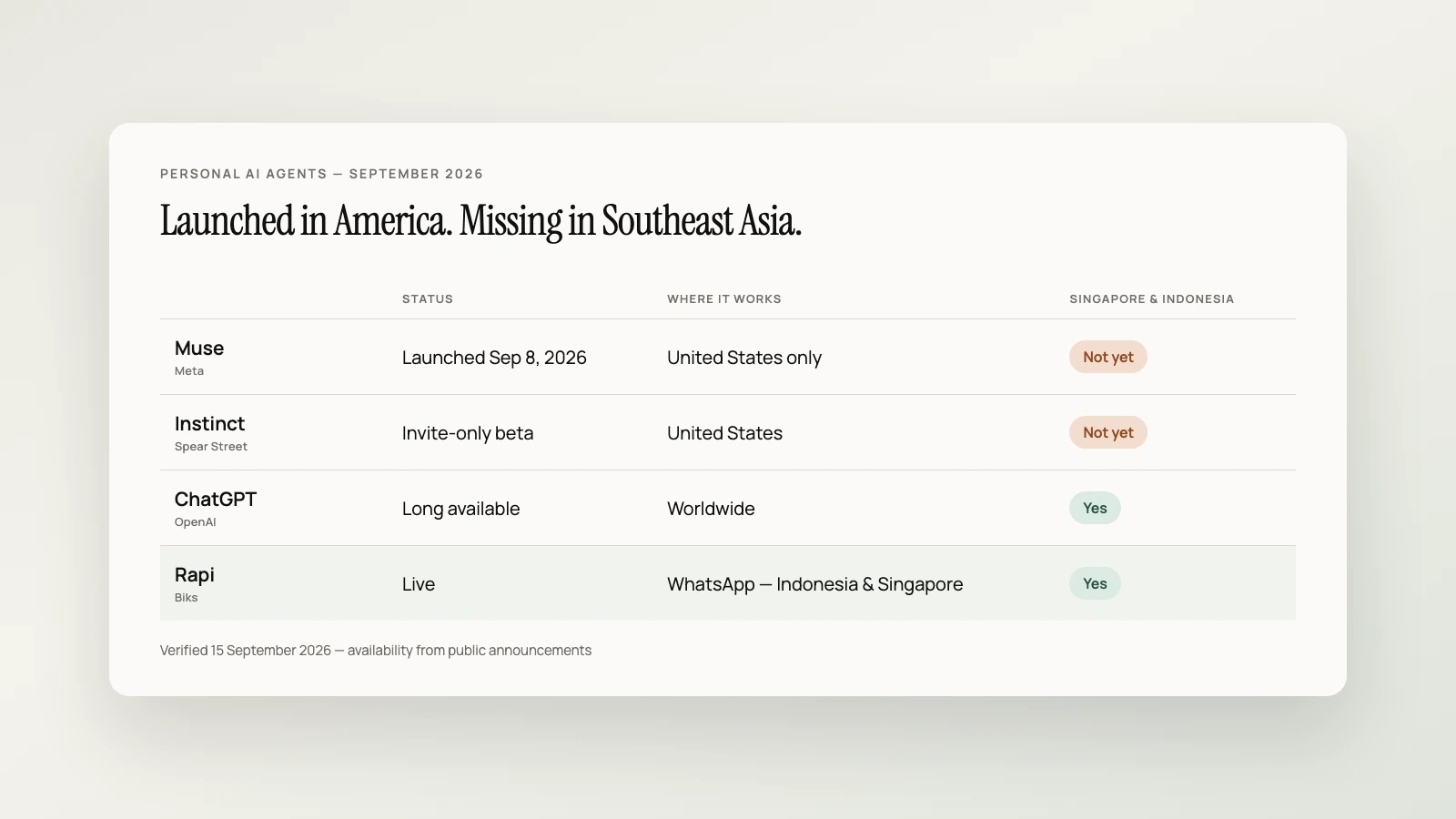
- Muse (Meta): Launched September 8, 2026, in the United States only. Free tier plus plans at 20 and 100 US dollars a month. No announced timeline for Singapore or Indonesia.
- Instinct (Spear Street): Still an invite-only private beta, reported at a 2.5 billion US dollar valuation in August 2026, with subscriptions reported between 200 and 500 US dollars a month once it opens. Not available in Southeast Asia.
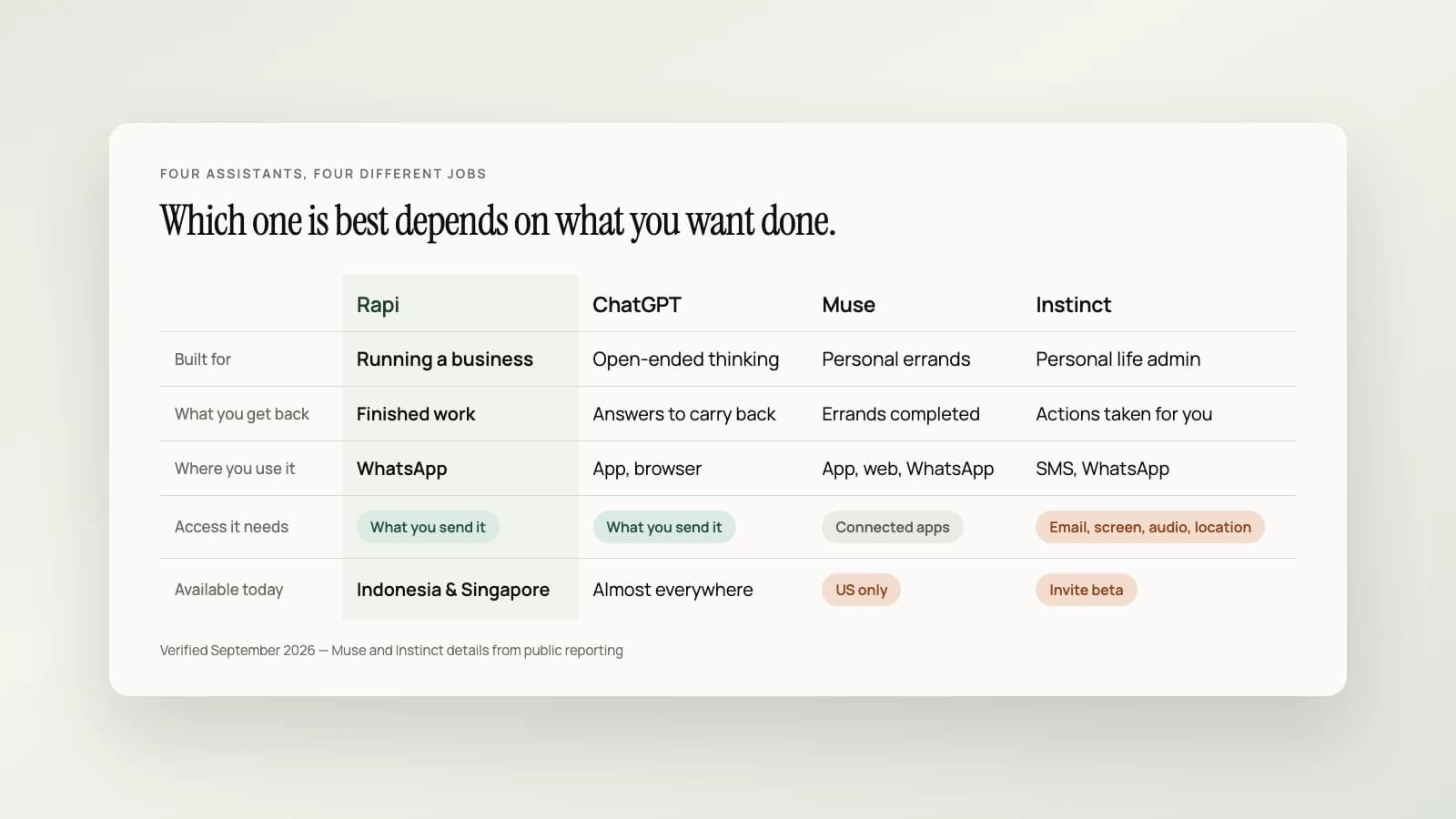
- ChatGPT (OpenAI): Available across Southeast Asia, free and paid. The strongest general-purpose assistant you can get here — but it is a place you go, not an agent inside your working day.
- Rapi (Biks): Live for businesses in Indonesia and Singapore today, working inside WhatsApp, taking new teams from a waitlist. Built for the work of running a business rather than personal errands.
Why this region keeps getting skipped — and why that is strange
US-first launches are rational for Meta and everyone else: one language, one app-store market, one regulator. But look at what gets skipped. Southeast Asia's digital economy crossed 300 billion US dollars in gross merchandise value in 2025, with revenue near 135 billion and both still growing about 15 percent a year, according to the e-Conomy SEA report by Google, Temasek and Bain. The same report finds consumer interest in AI here running at three times the global average.
The region also works differently. In Indonesia — roughly one hundred million WhatsApp users, and second in the world for WhatsApp Business app downloads — the working day does not happen across a dozen specialised apps. It happens in chat. An agent designed around the American app economy lands here missing the one surface that matters.
Which is why the practical answer to "when does the agent wave reach us" is not to wait for it. The assistants that already work here are the ones built around chat from the start.
The question that outlasts the launch date: what does it get to see?
Muse runs in a sandboxed VM — a genuinely good default for a consumer agent. Instinct sits at the other pole: it connects continuously to email, messaging, screen, audio and location, which is exactly what makes it capable and exactly what should give a business owner pause. ChatGPT sees what you paste into it, and nothing more.
Rapi is built on the same minimal principle, applied to business: it sees what you send it, and nothing else. Each business runs in an isolated environment, conversations are never used to answer anyone else, and it will never ask for a PIN, an OTP or a password. When agents handle contracts, payroll and customer data, the permission model is not a footnote — it is most of the decision.
What to do while the wave arrives
- Personal errands, and you are in the US: Try Muse. The sandboxed design is the right instinct for a consumer agent.
- Open-ended thinking, anywhere: ChatGPT remains the best general-purpose tool available in this region, and you probably already have it.
- Running a business in Indonesia or Singapore: Put the assistant where your day already happens — WhatsApp. In live Rapi deployments, executives have taken 20-plus hours a week of recurring admin down to under 30 minutes of review.
- Whichever you choose: Pick the one task that cost you the most time last week and run it through an assistant for a week. Real use answers this faster than any launch coverage, including this piece.
Common questions
- Is Muse available in Singapore or Indonesia?
- No. Muse launched on September 8, 2026 in the United States only, for users 18 and over, on iOS, Android and muse.ai. Meta has not announced a date for Singapore, Indonesia or any Southeast Asian market.
- How much does Muse cost?
- Muse is free for most everyday use, with paid plans at 20 and 100 US dollars a month for heavier or more capable use. Availability is limited to the United States as of September 2026.
- When will Muse come to Southeast Asia?
- Meta has not said. The September 8, 2026 announcement named a US rollout and support for AI glasses as next steps, with no regional expansion dates. Historically, Meta consumer AI features have reached Southeast Asia months after US launch.
- What can businesses in Southeast Asia use instead of Muse today?
- ChatGPT is available across the region for open-ended thinking. For the recurring work of running a business, Rapi by Biks is live for companies in Indonesia and Singapore and works inside WhatsApp. Instinct remains an invite-only beta with no Southeast Asia availability.
- Which personal AI agent is safest with business data?
- Judge by what each is permitted to see. Muse runs in a sandboxed VM so it does not hold your account credentials. Instinct connects continuously to email, messaging, screen, audio and location. ChatGPT sees what you paste. Rapi sees only what you send it, keeps each business in an isolated environment, and never asks for a PIN, OTP or password.