Singapore SME AI Adoption Tripled to 14.5%. Here's What the Other 85% Are Missing — and the Grants That Pay Half
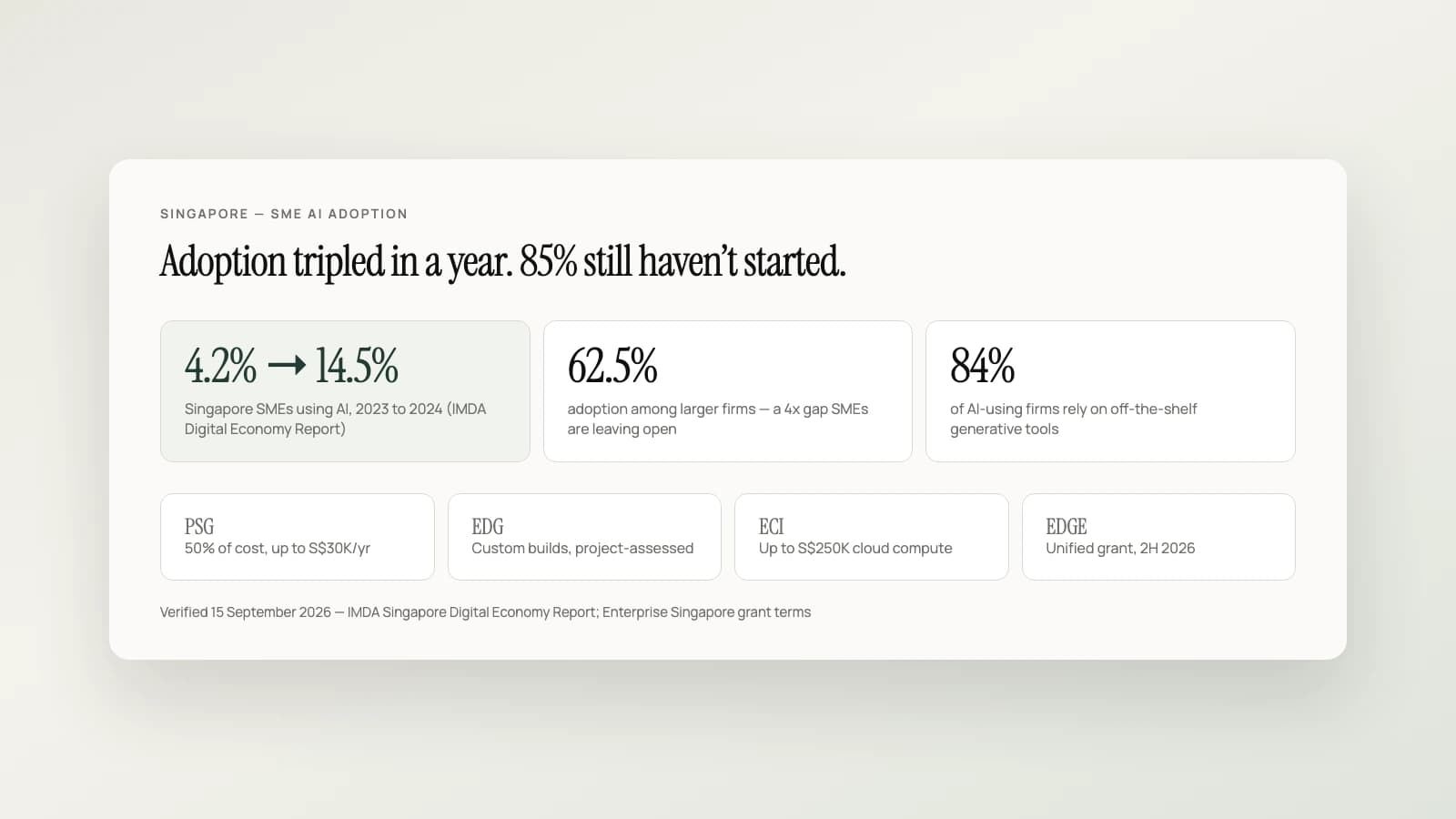
Singapore's SME AI adoption tripled in a single year — from 4.2 percent in 2023 to 14.5 percent in 2024, according to IMDA's Singapore Digital Economy Report. That is the fastest adoption jump the report has recorded, and it still leaves roughly 85 percent of SMEs on the sidelines while larger firms have already reached 62.5 percent.
The gap is not about belief. It is about time, fit and money — and the third one is the most solvable, because Singapore currently pays for a large share of SME AI adoption through grants that many owners have never applied to.
Here is the adoption picture, what the money actually covers, and the one deadline to know: the grant landscape itself is being reorganised in the second half of 2026.
The adoption gap, in numbers
- 14.5 percent: SMEs using AI in 2024, up from 4.2 percent the year before — a tripling, from a low base.
- 62.5 percent: AI adoption among larger firms, up from 44 percent. The capability gap between big and small is widening, not closing.
- 84 percent: Share of AI-using firms relying on off-the-shelf generative tools; only 44 percent use anything customised to their own operations.
- S$128.1 billion: Singapore's digital economy in the same report — 18.6 percent of GDP. The context that explains why the government subsidises adoption this heavily.
What the grants actually cover
- PSG (Productivity Solutions Grant): Pre-approved, off-the-shelf tools — customer-service bots, scheduling, document processing. Covers 50 percent of cost, up to S$30,000 a year. The fast lane: vendor quote in, reimbursement out.
- EDG (Enterprise Development Grant): Custom transformation — bespoke AI built around your workflows. No fixed cap; each project is assessed on a written proposal. The right lane when off-the-shelf does not fit how you work.
- ECI (Enterprise Compute Initiative): Up to S$250,000 toward cloud and compute for AI projects across the major providers.
- EDGE, in the second half of 2026: PSG, EDG and MRA are being unified into a single EDGE grant. If you have been putting an application off, the process you learned may be replaced — which is a reason to move, not wait.
Why 85 percent are still waiting — and what the 15 percent did
The honest blocker is rarely the subsidy. It is that most AI tools ask the business to change how it works, and an owner-operator has no slack for that. The adopters who got value did the opposite: they automated one existing workflow, inside tools the team already uses, and left everything else alone.
That pattern shows up consistently in our own deployments: document processing that took 30 minutes per item comes down to about 2 minutes, and month-end work that consumed 20-plus hours a week comes down to under 30 minutes of review — not by adding a new system, but by putting the assistant inside the existing one.
One workflow, measured before and after, funded at half cost by a grant. That is the whole playbook the 14.5 percent used. The only thing the 85 percent are missing is having started.
Common questions
- What percentage of Singapore SMEs use AI?
- 14.5 percent as of 2024, up from 4.2 percent in 2023, according to IMDA's Singapore Digital Economy Report. Larger firms are at 62.5 percent.
- Which Singapore grant covers AI tools for SMEs?
- The Productivity Solutions Grant (PSG) covers pre-approved AI tools at 50 percent of cost, up to S$30,000 a year. Custom AI builds go through the Enterprise Development Grant (EDG), assessed per project. The Enterprise Compute Initiative adds up to S$250,000 toward cloud compute.
- What is the EDGE grant?
- A unified scheme replacing PSG, EDG and MRA, announced for the second half of 2026. Existing schemes remain the route until it launches.
- Does custom-built AI qualify for a grant?
- Yes — through the EDG, which funds bespoke transformation work against a written project proposal rather than a vendor quote. It suits AI built around your own workflows rather than off-the-shelf tools.
- What results should an SME expect from one automated workflow?
- From our own deployments: document processing down from about 30 minutes per item to 2, and recurring back-office work down from 20-plus hours a week to under 30 minutes of review. Measure one workflow before and after; let that number decide the next one.