a16z on AI Agents: What Finance Leaders Should Take
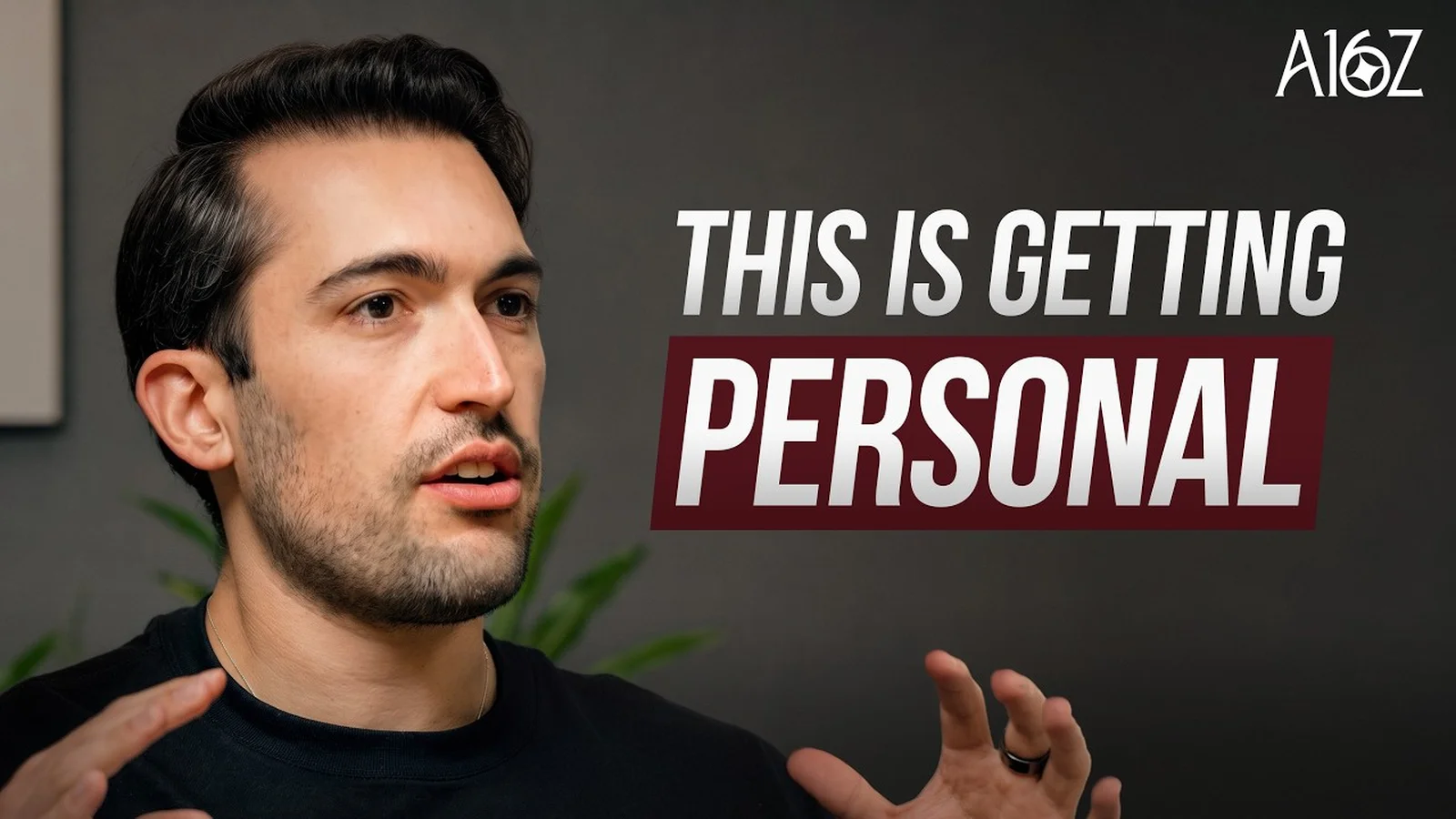
On The a16z Show of 4 November 2026, David Pawlan of Assistant Benchmark said 147 AI assistants have crossed his desk, and that trust is the top fear in 22% of messages from the AI power users he follows. The category that has not taken off yet, he said, is finance.
Most of the hour is about shopping, travel and agents that gossip with each other. None of that belongs in a bank. But listen as someone who sits on a credit committee, and five lessons come through, plus one from an October episode on agents that pay. This is our read.
Trust is the top fear, and finance is waiting for it
Pawlan runs group chats of AI power users. Across about 3,600 messages, he said, 22% name trust as the main fear. He sorts the assistants he tests into four groups: general, work, multiplayer and travel. Finance is missing. In his words, it is the one he has not seen "come to fruition yet".
Our read: that is not a coincidence. People hand an agent a restaurant booking long before they hand it a balance sheet. Finance moves last because the cost of a mistake is highest, which is also why the first assistant bankers trust will be hard to replace.
**Finance is not behind on AI. It is waiting for a reason to trust it.**
“If we can solve that trust layer, then what do we end up seeing on more of like the finance side of stuff?”
The real fear is embarrassment, not data theft
The hosts pushed back on the trust numbers with a sharper point. People say they worry about privacy, yet they connect bank accounts for trivial upside. What they really fear is being embarrassed. The example: a personal agent that spilled into work and posted its owner's finances into the company Slack.
For a banker, embarrassment has a precise shape. It is a wrong number, repeated in front of the board. That is why every figure an AI analyst produces needs a source and a date, and why sloppy basics, like a reply in the wrong chat, cost more trust than any missing feature.
**Nobody leaves an AI tool over a privacy policy. They leave it after one embarrassing meeting.**
Fences, not freedom
The episode borrows an analogy for agent permissions: a child in an open yard has to be watched, but put up a fence and the child can roam freely inside it. The agent gets full freedom within clear limits. The point made on air: a personal agent should reach personal channels, not work ones.
Banks already live by fences. Chinese walls separate deal teams from research and trading. An AI analyst needs the same walls built in: memory kept per person, per team and per conversation, and nothing one person shares used to answer someone else.
**The best agent is not the one with the most access. It is the one with the right fences.**
Judgment means holding two constraints at once
Pawlan's sharpest test asked assistants to send flowers that day, as cheaply as possible. Most found same-day delivery and quietly dropped the price. Only three, he said, gave the two goals equal weight. His question was whether an agent only prioritises the first thing you say.
Bankers ask two-constraint questions all day. Short but complete. The latest figures, but only from official sources. An assistant that keeps one and drops the other produces a brief that has to be rewritten, which is worse than no brief at all.
**Following one instruction is a search box. Balancing two is an analyst.**
Memory is portable, so quality is the only moat
Pawlan asked the top 15 assistants on his benchmark to export everything they remembered about him so he could switch. All but one did. Pasting a memory file from one assistant into another is now, as one host put it, a common onboarding pattern.
Our read: an assistant can learn a new user on day one, and lose them just as fast. Lock-in is gone. The only reason to stay is that the work is better. The episode adds a warning on how not to keep users: one host with 30 years in consumer products said paternalism kills any product.
**If your memory can leave in a minute, your quality has to earn the next one.**
The secret superpower, for a banker
The episode closes on agents becoming a secret superpower. For a finance leader, that is simple: walking into committee as the best-informed person in the room, without staying up until midnight. Before any agent touches board work, ask three questions. Does it keep two constraints? Does every number show its source and date? Can you trace what it read?
If the answers are vague, the agents in this episode will do fine for your weekend. They are not ready for your Monday.
Sources
- The a16z Show: The New AI Agents That Shop, Plan, and Gossip (4 November 2026)
- a16z (YouTube): The New AI Agents That Shop, Plan, and Gossip (video, 4 November 2026)
- The a16z Show: When AI Agents Start Spending Your Money, with Alex Rampell and Terry Angelos (15 October 2026)
- a16z (YouTube): Agentic Commerce: Why Your Wallet Is About to Change (video, 15 October 2026)
- Monetary Authority of Singapore: MAS Sets Out Supervisory Expectations on Responsible AI Adoption by Financial Institutions (7 October 2026)
- Otoritas Jasa Keuangan: Peluncuran Tata Kelola Kecerdasan Artifisial Perbankan Indonesia (SP 67/GKPB/OJK/IV/2025)
Common questions
- What did the a16z Show say about AI agents?
- On 4 November 2026, David Pawlan of Assistant Benchmark said 147 AI assistants have crossed his desk and that trust is the top fear in 22% of about 3,600 messages from AI power users. He said finance is the category that has not taken off yet. The episode also covered memory, judgment, shopping and agent-to-agent social features.
- Are AI shopping agents relevant to banks?
- Mostly not. Shopping and agent-to-agent social features are consumer use cases, and sharing client information between agents is a compliance risk. What carries over to banking is the frame used to judge agents: memory, judgment and trust, plus the question of who is accountable when an agent acts on your behalf.
- Who is accountable when a bank uses a third-party AI tool in Singapore?
- The bank. MAS's Guidelines on AI Risk Management, issued on 7 October 2026, say financial institutions remain accountable for third-party AI they use and should obtain sufficient assurance from providers. The expectations start applying from 7 October 2027, with some sections due by 7 October 2028.
- What should finance leaders test in an AI agent first?
- Three things: whether it keeps two constraints at once (short but complete, current but official), whether it shows the source and date behind every figure, and whether you can trace what it read when it gets something wrong. Those map to the judgment, trust and accountability questions in both episodes.