
Free AI Tools for SMEs in Singapore: IMDA's 2026 List
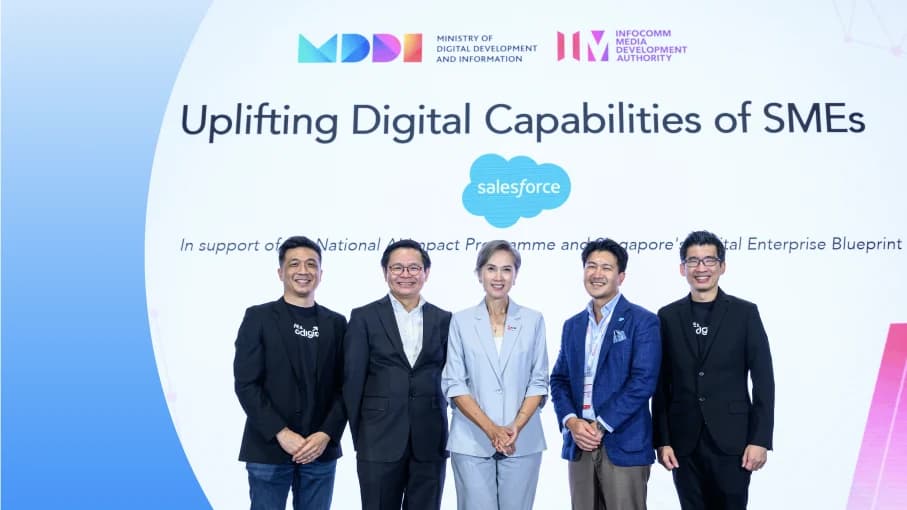
IMDA's free AI tools for SMEs in Singapore are 116 curated global tools on the SMEs Go Digital portal, each with a free tier or free trial, plus three partner programmes giving free trials of Slack, Singtel's SPACES and Beyondsoft's retail and F&B AI solutions.
IMDA announced all of this on 13 October 2026 at SMEs Go Digital Day, alongside a push to make more pre-approved solutions AI-enabled and the switch from PSG to the EDGE Grant. This guide explains each programme, who qualifies and how to apply, maps the 116 tools into nine categories with a deeper guide for each, and shows how to choose your first tool without wasting a free trial.
Key takeaways
- 116 tools, all with a free way in: IMDA's new AI Tools page lists 116 global AI tools, each with a free tier or free trial, filtered by Finance, HR, Sales & Marketing, Operations and AI Workplace Productivity.
- Three free partner programmes: Slack AI Launchpad (up to 1,000 SMEs), Singtel Stack-EZ (up to 10,000 SMEs) and Beyondsoft Tech Bridge (up to 1,000 retail, wholesale and F&B SMEs).
- Free tools are not grant-supported: The 116 tools are a curated list, not pre-approved solutions. Grant support of up to 50% now runs through the EDGE Grant and IMDA's pre-approved list.
- PSG has closed: PSG, EDG and MRA ceased on 29 September 2026; from 30 September SMEs apply under the EDGE Grant.
- Start with one workflow, not one tool: A free trial pays off only when you pick the job first, measure it today and decide what result would make you keep the tool.
What free AI support did IMDA announce for SMEs?
Here is everything announced on 13 October 2026 that costs an SME nothing to start, side by side.
| Programme | Who it's for | What you get free | How long | How to apply |
|---|---|---|---|---|
| AI Tools page (SMEs Go Digital) | Any business | 116 curated global AI tools, each with a free tier or free trial from the vendor | Depends on each vendor's terms | Browse smesgodigital.gov.sg and sign up on the vendor's site |
| Slack AI Launchpad (Salesforce + IMDA) | Up to 1,000 SMEs | Slack Business+ for up to 10 users, plus two hands-on workshops to build at least one AI-enabled workflow | 60-day trial; programme runs two years | Via the programme page on SMEs Go Digital |
| Stack-EZ AI Data Enablement Programme (Singtel + IMDA) | Up to 10,000 eligible SMEs | SPACES, an AI document management tool that extracts data from documents into CRM and HR systems | Six months free, then a paid subscription; programme runs two years | Via the programme page on SMEs Go Digital |
| Tech Bridge (Beyondsoft + IMDA) | Up to 1,000 retail, wholesale and F&B SMEs | Trial of five China-market AI solutions localised for Singapore | 60-day trial | Apply via SMEs Go Digital; first showcase on 5 November 2026 |
IMDA also reported that 55% of pre-approved solutions on the SMEs Go Digital platform are now AI-enabled, past its earlier 50% target, and set a new goal of 70% within two years. A new Package Builder lets SMEs customise pre-approved packages, add-ons and training support. Those pre-approved solutions are paid products, but they are the ones that qualify for grant support.
The context is adoption. IMDA's Singapore Digital Economy Report shows SME AI adoption rising from 14.5% in 2024 to 23.4% in 2025. We covered the numbers behind that in Singapore SME AI adoption hits 23.4%, and the 30 winners of the first SME AI Impact Awards, chosen from 290 nominations, in what the award winners show.
What is the Slack AI Launchpad?
- Who: Up to 1,000 Singapore SMEs, run by Salesforce with IMDA over two years.
- What: A free 60-day (two-month) trial of Slack's Business+ plan for up to 10 users, plus two hands-on workshops. GovInsider reports the workshops help you identify AI use cases and build at least one AI-enabled workflow for a real business need.
- How long: Two months of free access per SME; the programme itself runs for two years.
- How to apply: Through the programme's page on the SMEs Go Digital portal.
This suits a team of up to ten people whose work is lost in WhatsApp groups and email threads: a renovation contractor coordinating site supervisors, or an accounting firm passing client files between partners and associates. The workshop is the valuable part. Two months is short, so go in with one workflow in mind, such as a daily site report or a client document request, rather than a general wish to use Slack.
The honest limit: if your customers and suppliers live in WhatsApp, Slack only fixes the internal half of the conversation. Ask early how the workflow you build will connect to the channels your customers already use.
What is the Singtel Stack-EZ AI Data Enablement Programme?
- Who: Up to 10,000 eligible SMEs, run by Singtel with IMDA over two years. Eligibility follows Singtel's criteria, so check the programme page.
- What: Six months of free access to SPACES, Singtel's AI document management tool. It extracts information from documents such as invoices, contracts and receipts and organises it into data that can go into your CRM or HR systems.
- How long: Six months free, then a paid subscription if you continue.
- How to apply: Through the programme's page on the SMEs Go Digital portal.
Of the three partner programmes, this one goes most directly at the problem that stops AI working in small businesses: data scattered across email, shared drives and paper. A logistics SME with delivery orders in PDFs, or a clinic with supplier invoices in an inbox, is the kind of business it is aimed at.
Before you sign up, decide what happens after month six. If you would not pay to keep it, use the six months to clean up and structure your documents in a form you can take elsewhere, so the effort is not lost.
What is Beyondsoft Tech Bridge?
- Who: Up to 1,000 SMEs in retail, wholesale and food and beverage, with other sectors to be added over time according to GovInsider.
- What: A free 60-day trial of five AI solutions from the China market, localised for Singapore: AI Store Manager, AI Sales Assistant, AI Market Insight Platform, AI Business Intelligence Pro and AI Accounts Payable Assistant. Beyondsoft's announcement says they come with English interfaces and Singapore data residency compliance, plus onboarding support.
- How long: 60 days per SME.
- How to apply: Through the SMEs Go Digital portal. The first showcase, where you can see the solutions and meet the providers, is on 5 November 2026.
A café group, a neighbourhood minimart or a wholesaler with a sales team is the target here. The AI Accounts Payable Assistant is the one to look at if supplier invoices pile up at month-end; AI Store Manager and AI Sales Assistant are aimed at the front of house.
The showcase is worth the visit even if you do not sign up, because 60 days goes fast. Ask each provider how the solution connects to your POS, your accounting software and the way you take orders today.
What is on IMDA's AI Tools page?
The AI Tools page on the SMEs Go Digital portal lists 116 global AI tools. Every one has a free tier or free trial, and each listing links straight to the vendor. You can filter by Finance, Human Resources, Sales & Marketing, Operations and AI Workplace Productivity.
IMDA describes the list as curated from multiple sources, considering signals of market adoption with generally positive user sentiment and relevance to local SME needs. In plain terms, these are well-used tools that IMDA thinks are relevant to Singapore businesses. It is not an endorsement of any one tool, and it is not a grant list: the 116 tools are not pre-approved solutions, so subscriptions to them do not get grant support through this page.
The list is global and off-the-shelf. It includes big names such as ChatGPT, Microsoft 365 Copilot, Canva and Xero, newer Chinese models such as DeepSeek, Kimi and Qwen Studio, and builder tools such as Lovable and Bubble. Free terms vary widely, from permanent free plans to short trials, and they change, so always check the vendor's own pricing page before you commit your team's time.
Which 116 AI tools are on IMDA's list?
We grouped the 116 tools into nine categories by the job they do. Each category has its own guide with free terms, strengths and limits.
| Category | Tools | Examples (as IMDA lists them) | Full guide |
|---|---|---|---|
| AI assistants | 14 | ChatGPT, Claude, Gemini, Microsoft 365 Copilot, Perplexity | Free AI assistants |
| Agents, chat & customer service | 18 | Wati, WhatsApp Business, Tidio, Freshdesk, Zendesk for Customer Service | Free AI customer service tools |
| Sales & CRM | 11 | HubSpot Sales Hub, Pipedrive, Zoho CRM, Apollo.io, monday CRM | Free AI sales and CRM tools |
| Marketing & email | 7 | Klaviyo, Brevo Marketing Platform, Intuit Mailchimp Email Marketing, Copy.ai | Free AI marketing and email tools |
| Design & images | 12 | Canva, Figma, Adobe Firefly, Midjourney, Leonardo.Ai | Free AI design tools |
| Video & audio | 18 | CapCut, HeyGen, Synthesia, VEED, ElevenLabs | Free AI video tools |
| Finance, HR & ERP | 7 | Xero, QuickBooks Online, Odoo ERP, Deel Payroll, BambooHR | Free AI finance and HR tools |
| Workplace & projects | 16 | Google Workspace, Microsoft 365, Notion, ClickUp, Lark | Free AI workplace tools |
| App, website & code builders | 13 | Lovable, Glide, Bubble, Shopify, Wix | Free AI app and website builders |
| Total | 116 |
A few notes from going through the list. The agents and customer service group is the largest alongside video, and it is where WhatsApp-heavy businesses should look first. The finance, HR and ERP group is small but matters most for compliance: IMDA itself marks BambooHR as not supporting Singapore payroll, so check local payroll, GST and CPF handling before you move any finance or HR process.
If you only have time for one guide, start with the category closest to your biggest weekly time sink. For most owner-run SMEs that is either customer messages or invoices and books.
Free tools vs pre-approved solutions vs the EDGE Grant
These three are often confused. They solve different problems and are funded differently.
| IMDA AI Tools page | Pre-approved solutions | EDGE Grant | |
|---|---|---|---|
| What it is | 116 curated global AI tools with a free tier or trial | Solutions vetted by IMDA on the SMEs Go Digital platform; 55% are now AI-enabled | Enterprise Singapore's grant that replaced PSG, EDG and MRA from 30 September 2026 |
| Cost to you | Free to start; vendor pricing applies after | Paid, with grant support available | Covers up to 50% of qualifying costs for SMEs |
| Grant support | No | Yes, up to 50% through EDGE | Up to S$100,000 per company per year, of which up to S$30,000 for single-function digital solutions, integrated enterprise systems and pre-scoped equipment |
| Who qualifies | Anyone | Businesses buying through the platform | Singapore-registered, at least 30% local (citizen or PR) shareholding |
| Best for | Trying AI on one job before spending | A proven, supported solution you plan to keep | Funding a larger digital or transformation project |
A sensible path is to use a free tool to learn what you actually need, then look at pre-approved solutions or an EDGE-supported project once you know. The Package Builder helps at that second step by letting you bundle a solution with add-ons and training.
How does the EDGE Grant work now that PSG has closed?
The Productivity Solutions Grant, the Enterprise Development Grant and the Market Readiness Assistance grant ceased on 29 September 2026. From 30 September, SMEs apply under the EDGE Grant. Projects already approved under the old schemes continue to completion.
EDGE supports up to 50% of qualifying costs for SMEs, capped at S$100,000 per company per year across all activities. Up to S$30,000 of that can go to single-function digital solutions, integrated enterprise systems and pre-scoped equipment. To qualify, your business must be registered in Singapore with at least 30% local shareholding by Singapore citizens or permanent residents.
For digital tools, IMDA's pre-approved list is still the place to check first. We keep a fuller explainer in Singapore SME AI grants, including what counts as a qualifying cost.
How do you pick your first AI tool?
Six steps that work whether you run a café, a clinic or a ten-person accounting firm.
- 1. Name the job, not the tool: Write down the one task that eats the most hours each week: answering order questions, chasing payments, matching bank lines, writing quotes.
- 2. Measure it today: Time it for one week. "Four hours a day" or "two days at month-end" is the number your trial has to beat.
- 3. Pick the category, then shortlist two tools: Use the table above and the matching guide. Compare free terms, Singapore support (payroll, GST, PayNow) and whether it works with what you already use, such as WhatsApp, Xero or Google Sheets.
- 4. Check the data side: Know where the tool stores your data and what customer data you would put in it. Under the PDPA you remain responsible for personal data you share with a vendor.
- 5. Trial with a decision date: Put the end of the free trial in the calendar and decide in advance what result makes you keep or drop the tool.
- 6. Give one person ownership: Someone has to set it up, check its output and keep it running. If nobody owns it, the trial ends quietly and nothing changes.
If you are unsure whether you need a simple assistant or something that acts on your systems, AI agent vs chatbot explains the difference in plain terms.
What do free AI tools not do for you?
- Setup around your business: Your price list, your approval limits, your customer terms. Someone has to configure them, and free plans often limit the features you need to do so.
- Connections to your other tools: The order arrives in WhatsApp, the stock is in a spreadsheet and the invoice goes into Xero. Most tools handle one of those well; the handoffs between them stay manual.
- Your own rules and approvals: Who can approve a refund, which supplier invoices need a second look, what goes to the customer without a check. Generic tools rarely know.
- Data cleanup: AI is only as good as the records behind it. Duplicate customers and missing invoice numbers come along into any new tool.
- Someone accountable every day: When the tool gets something wrong at 9pm on a Friday, someone has to notice and fix it.
A free tool gives you a capability. It does not give you a working process. The gap is usually the same five things.
Tool on its own vs tool + Biks
Both are valid. Here is when each fits.
| Free AI tool on its own | Your tools + Biks | |
|---|---|---|
| Setup | You set it up yourself from the vendor's templates and help docs | Biks maps your workflow and builds it around your existing tools |
| Connects to WhatsApp, Xero, Sheets | Depends on the tool and plan; often one or two native connections | Built to connect the tools you already use, including WhatsApp, Xero and Google Sheets |
| Your approval rules | Whatever the tool's settings allow | Your rules built in; payments and customer-facing actions wait for a person to approve |
| Who runs it day to day | Your team | Biks runs and monitors it; your team reviews and approves |
| Cost model | Free tier or trial, then a subscription | One-time build plus a monthly subscription, usually compared with the cost of hiring an admin |
| Best when | The job is common, sits inside one tool and someone on your team has time to own it | The job crosses several tools, depends on your own rules, and nobody has time to run it |
How Biks can help
Biks is not on IMDA's list, because the list covers off-the-shelf global tools. We build and run custom AI workflows for SMEs on top of the tools you already use: Xero, QuickBooks Online, Google Sheets, WhatsApp Business and others on the list. For finance and accounting that means bank lines matched to invoices, supplier bills recorded and payments chased, with a person approving anything that moves money. In one run, a professional-services firm matched 297 of 297 billing lines across 18 projects; in another, 126 of 128 transactions matched without a person touching them.
On the customer side, customer operations turns WhatsApp orders into recorded orders, payments and deliveries. Rosalie, an F&B business, cut daily order admin from more than four hours to about 20 minutes and went live in three weeks; see the Rosalie case study. If you have tried a free tool and hit the gaps above, book a call and bring the workflow you measured. Most go live in weeks.
Common questions
- What free AI tools does IMDA recommend for SMEs?
- IMDA's AI Tools page on the SMEs Go Digital portal lists 116 curated global AI tools, each with a free tier or free trial. They include ChatGPT, Claude, Gemini, Canva, Notion, Xero, Wati and Lovable, filterable by Finance, Human Resources, Sales & Marketing, Operations and AI Workplace Productivity. IMDA says the list considers market adoption, user sentiment and relevance to local SMEs.
- Are the tools on IMDA's AI Tools page eligible for grants?
- No. The 116 tools on the AI Tools page are a curated list, not pre-approved solutions, so they are not grant-supported through that page. Grant support of up to 50% of qualifying costs applies to IMDA pre-approved solutions and other qualifying projects under the EDGE Grant, which replaced PSG from 30 September 2026.
- How can a Singapore SME get Slack for free?
- Through the Slack AI Launchpad, run by Salesforce and IMDA. Up to 1,000 SMEs get a free 60-day trial of Slack Business+ for up to 10 users, plus two hands-on workshops to build at least one AI-enabled workflow. The programme runs for two years, and you apply through the SMEs Go Digital portal.
- What is the Beyondsoft Tech Bridge programme?
- Tech Bridge is a Beyondsoft and IMDA programme for up to 1,000 Singapore SMEs in retail, wholesale and F&B. It offers a free 60-day trial of five China-market AI solutions localised for Singapore: AI Store Manager, AI Sales Assistant, AI Market Insight Platform, AI Business Intelligence Pro and AI Accounts Payable Assistant. Apply via SMEs Go Digital.
- Is the PSG grant still available in Singapore?
- No. The Productivity Solutions Grant, Enterprise Development Grant and Market Readiness Assistance ceased on 29 September 2026. From 30 September, SMEs apply under the EDGE Grant, which supports up to 50% of qualifying costs, capped at S$100,000 per company per year, with up to S$30,000 for single-function digital solutions.