Anthropic IPO: What the Numbers Mean for AI Users
Those two numbers are the story for anyone who uses AI at work. Intelligence is getting cheaper per unit, and businesses are buying far more of it. The filing also shows what pays for that: more than $265 billion in committed spending on computing power, a heavy reliance on cloud marketplaces, and a reported loss driven mostly by an accounting charge.
We read the filing, Anthropic's price lists since 2024, and the latest adoption data for Singapore and Indonesia. Below: how fast Anthropic is growing, whether it makes money, what happened to the price of AI, how many businesses actually use it, the risks, and what to watch next. This is analysis, not investment advice.
Key takeaways
- Growth: Revenue rose from $386 million in 2024 to $4.6 billion in 2025 and $16.3 billion in the first half of 2026, per the filing's financial statements.
- Cheaper AI: The top 2024 tier, Opus, fell from $15 to $4 per million input tokens. A new, pricier top tier (Fable 5.1, $10) now sits above it.
- Big buyers drive it: More than 11,900 customers paid Anthropic $100,000 or more in the past year, up from more than 950 a year earlier.
- Adoption gap at home: IMDA counts 23.4% of Singapore SMEs using AI, against 70.4% of larger firms. Indonesia has no official figure; private surveys range from 38% to 74%.
- Still blank: The share price range and the October run-rate revenue are left blank in the public filing.
What did Anthropic file on 26 October 2026?
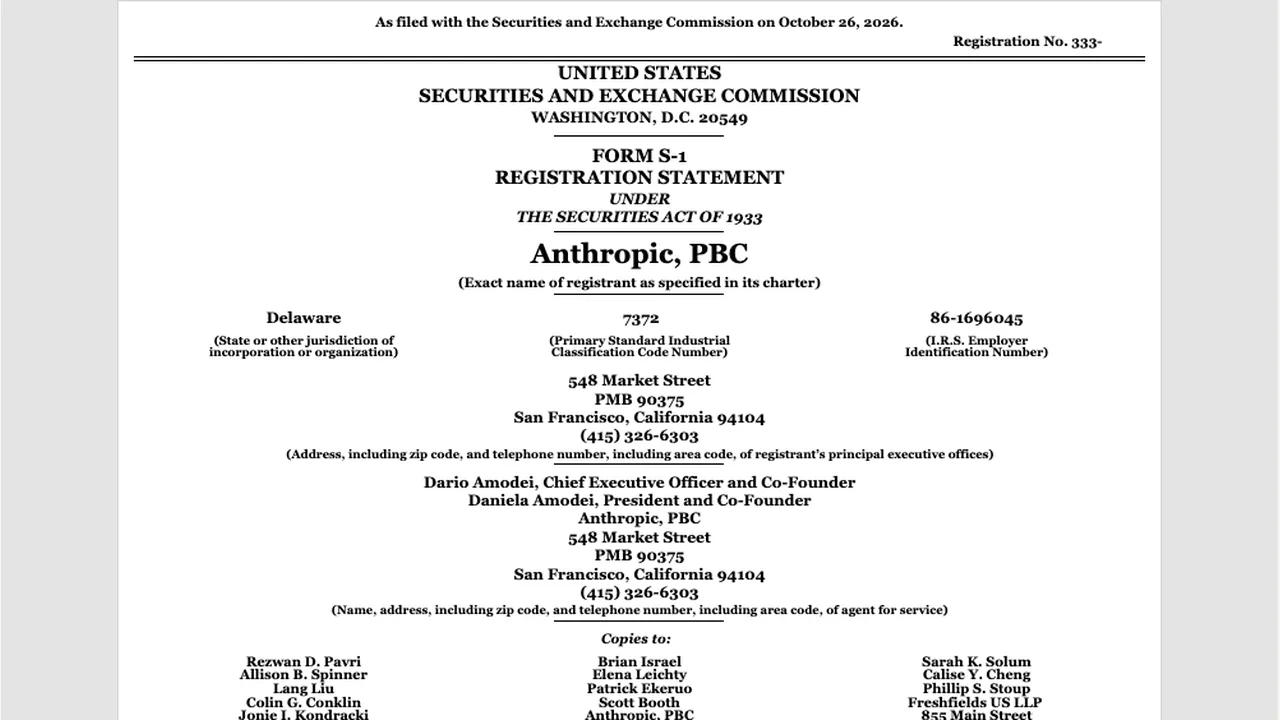
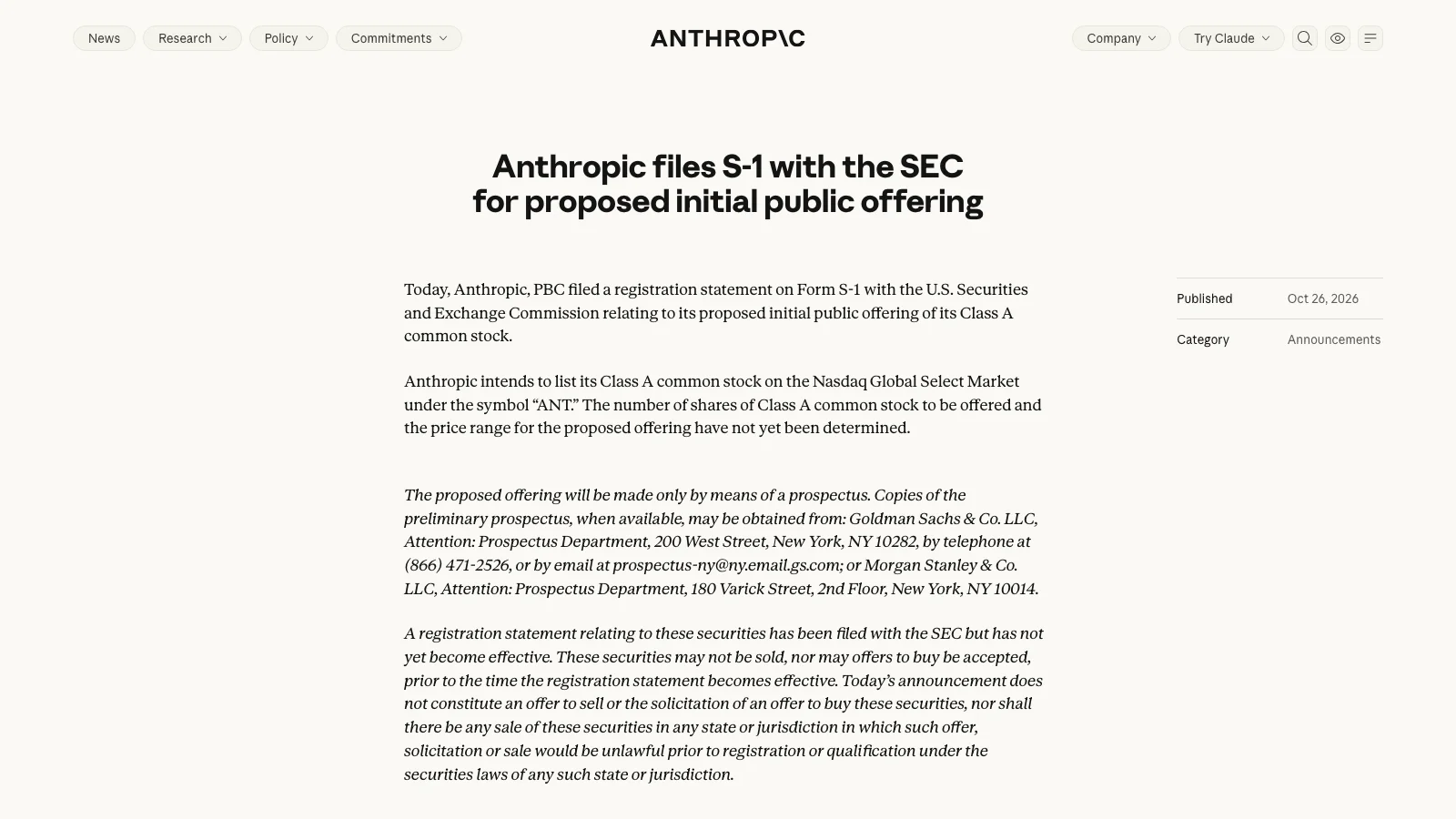
Anthropic, PBC filed its IPO registration statement with the U.S. Securities and Exchange Commission for its Class A shares, to list on the Nasdaq Global Select Market under the symbol "ANT". Goldman Sachs and Morgan Stanley head the list of underwriters.
The financial statements are filled in. What is blank is the price range, the number of shares and a few headline figures, including revenue run-rate "as of October 31, 2026". Those usually arrive in an amended filing before the shares are priced.
How fast is Anthropic growing?
| Measure (from the filing) | Earlier | Latest |
|---|---|---|
| Revenue, full year | $386 million (2024) | $4,585 million (2025) |
| Revenue, first half | $1,163 million (H1 2025) | $16,286 million (H1 2026) |
| Customers paying $100,000+ a year | More than 950 (Sept 2025) | More than 11,900 (Sept 2026) |
| Customers paying $1 million+ a year | Not disclosed | More than 1,900 |
| Smaller customers (under $100,000) | Not disclosed | About 40 million |
| Employees | About 940 (Dec 2024) | About 5,300 (Sept 2026) |
| Revenue through cloud marketplaces | 32% (2024) | 48% (H1 2026) |
Our read: the growth is enterprise-led. A net revenue retention of about 900% means existing customers spent roughly nine times more than a year before. That is less about new sign-ups and more about companies putting Claude into more of their work.
Nearly half of revenue now arrives through the marketplaces of the big cloud providers (AWS, Google Cloud and Microsoft Azure), which the filing describes as a channel it pays a fee to use. The same kind of companies also supply much of Anthropic's computing power.
Does Anthropic make money?
On paper, no. The filing reports a net loss of $80.7 billion for the first half of 2026. But $72.4 billion of that is a non-cash change in the fair value of convertible notes and similar instruments, an accounting effect of the company's rising valuation rather than money spent.
The operating loss, which is closer to the cost of running the business, was $693 million in the first half of 2026, down from $8.1 billion for all of 2025. Computing and infrastructure cost $8.9 billion in the same half-year, more than half of revenue.
Our read: the core business is close to breaking even at a very large scale, and the money question is now about computing power. Whoever sells AI must keep buying chips, data centres and electricity ahead of demand.
What happened to the price of AI?
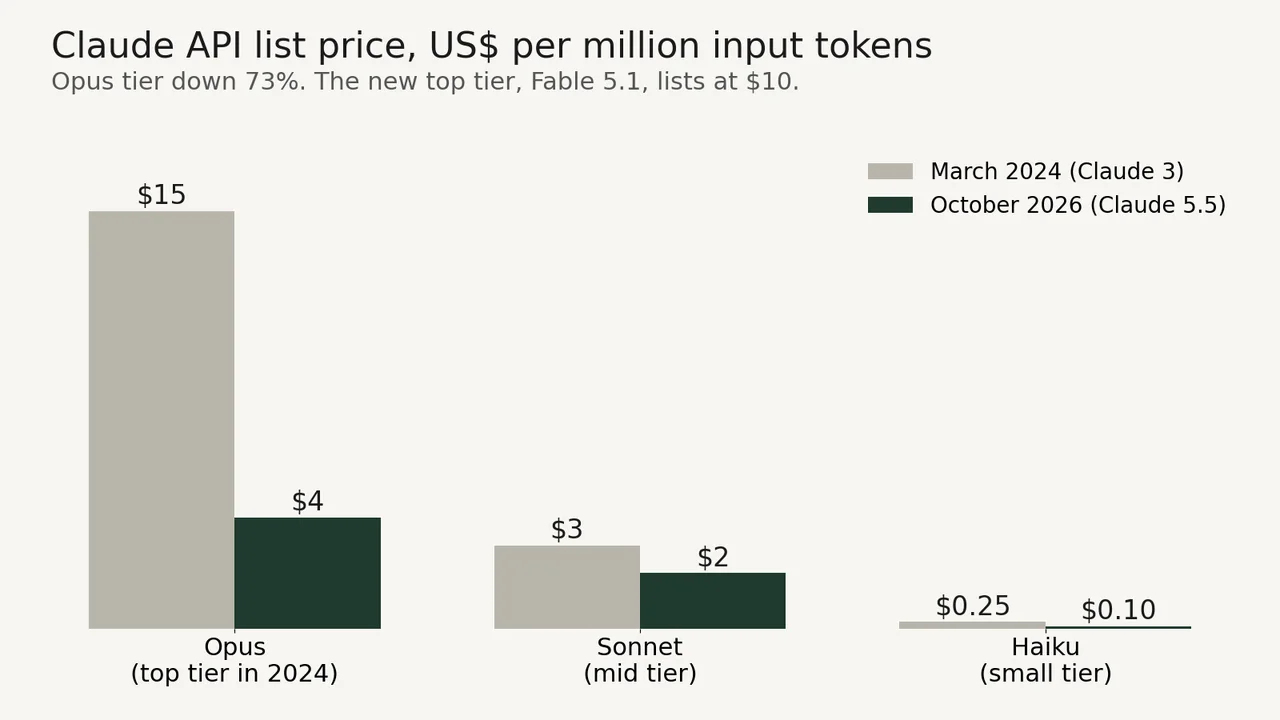
Anthropic's list prices per million tokens (input / output, US$). A token is roughly three-quarters of a word.
| Model tier | March 2024 | October 2026 | Change (input) |
|---|---|---|---|
| Opus (top tier in 2024) | $15 / $75 (Claude 3 Opus) | $4 / $20 (Opus 5.5) | −73% |
| Sonnet (mid tier) | $3 / $15 | $2 / $10 (Sonnet 5.5) | −33% |
| Haiku (small tier) | $0.25 / $1.25 | $0.10 / $0.50 (Haiku 5.5, prompts up to 100K tokens) | −60% |
| New top tier | Did not exist | $10 / $50 (Fable 5.1) | New |
| For comparison: OpenAI flagship | $10 / $50 (gpt-6-astra) | ||
| For comparison: Google | $2 / $10 (Gemini 4 Argon; $4 / $20 from 1 Dec 2026) |
The filing makes the same point in its own words: customers' cost per task falls because newer models finish tasks more efficiently and because Anthropic may cut prices. It says Fable 5.1 cut the cost of typical workloads by about 25% against Fable 5, and that Opus 5.5 lowered cost per task by about 40%.
The other half of the story is spending. The filing says enterprise users without Claude Code spend under $75 a month, while the top 5% who use it spend about 20 times that. Cheaper tokens did not shrink bills; they made people use AI for bigger jobs.
Our read: the price that matters is cost per finished task, not cost per token. A pricier model that gets a job right the first time can be cheaper than a cheap one that needs three attempts and a person to fix it.
How many businesses actually use AI?
| Market | Figure | Source and date |
|---|---|---|
| Singapore SMEs | 23.4% use AI (up from 14.5%) | IMDA Singapore Digital Economy Report, Oct 2026 (2025 data) |
| Singapore larger firms | 70.4% (up from 62.5%) | IMDA, Oct 2026 |
| Singapore workers | 85.7% use AI at work | IMDA, Oct 2026 |
| Indonesia SMEs | 38% have adopted AI | AWS-commissioned Strand Partners study, Aug 2026 (1,000 leaders) |
| Indonesia SMEs | 74% have implemented AI | UOB Business Outlook Study, Jun 2026 (272 SMEs) |
| United States, all firms | 17–20% use AI | U.S. Census Bureau, May 2026 |
| Claude use per person | Singapore 4.57× its population share; Indonesia 0.36× | Anthropic Economic Index, Sept 2025 |
Two gaps stand out. In Singapore, large firms use AI three times as often as SMEs. Between the two markets, people in Singapore use Claude at more than ten times Indonesia's rate relative to population, by Anthropic's own index.
Indonesia has no official business AI adoption figure from BPS or Komdigi. The two private surveys differ by 36 points because they ask different questions of different samples, so treat both as signals, not a census.
Anthropic's January 2026 index also found that on Claude.ai, 52% of conversations were augmentation (a person working with the AI) and 45% automation, while about three-quarters of business use through the API was automation.
Where is the money going?
Into computing power. The filing puts fixed or minimum commitments under its compute agreements at about $265.6 billion as of 30 June 2026, with terms of one to 20 years, and describes further agreements signed since. It runs one pool across Amazon's Trainium chips, Google's TPUs and NVIDIA and AMD graphics processors.
Press reports add the context the filing does not: The Wall Street Journal reported a possible raise of $100 billion or more and a listing as early as the week of 16 November, and Reuters reported investor valuations around $1.5 trillion. These are attributed to people familiar with the matter and may change.
What does the IPO mean for people who use AI?
| For users | Why, from the filing | Our read |
|---|---|---|
| Lower cost per task | Newer models finish tasks with less compute; Anthropic says it may keep cutting prices. | Likely to continue, but top tiers can cost more. |
| More capacity | Hundreds of billions committed to computing power. | Fewer limits and faster models over time. |
| Public accounts | A listed company reports audited results and risks every quarter. | Easier to judge a vendor you depend on. |
| Mission in the charter | A public benefit corporation; its Long-Term Benefit Trust can generally elect most of the board. | Safety stays on the agenda under market pressure. |
| Open connections | Its Model Context Protocol is an open standard now held by the Linux Foundation. | Integrations are less tied to one model. |
What are the risks and open questions?
- Concentration in supply: The same few cloud companies sell Anthropic its computing power and nearly half its revenue. The filing lists outages, capacity limits and renegotiated terms as risks.
- The cost of staying ahead: Long-term compute commitments must be paid whether or not demand keeps rising.
- Security of agents: The filing notes that agents like Claude Code and Claude Cowork need broad permissions inside customer systems, which raises the stakes of any security failure.
- What is not yet known: The share price range, the October run-rate revenue and the final size of the offering.
Can people in Singapore or Indonesia buy Anthropic shares?
Not in the offering itself as members of the public. The prospectus is not registered with the Monetary Authority of Singapore, so the offer in Singapore is limited to institutional and accredited investors. For Indonesia, it states the document is not a public offering under the Capital Market Law.
Once shares trade on Nasdaq, access depends on your broker and local rules. This article does not recommend buying, selling or holding any security.
What should you watch next?
- An amended filing: It will add the price range and the October run-rate revenue.
- Listing date: The Wall Street Journal reported the week of 16 November 2026; not confirmed by Anthropic.
- 1 December 2026: Google's Gemini 4 Argon price rises to $4 / $20 per million tokens, a test of whether AI prices keep falling.
- IMDA and Indonesia data: The next IMDA survey, and whether BPS or Komdigi publish an official business AI adoption rate.
What should a business using AI do now?
- Measure cost per task: Track what one finished job costs (an invoice matched, an order confirmed), not the price per token.
- Avoid single-model lock-in: Keep your data, instructions and approvals in your own workflow so the model can be swapped when prices or quality change.
- Re-check prices quarterly: List prices moved several times in two years, in both directions.
- Keep people on the decisions that matter: Payments, refunds, contracts and customer commitments stay with a named owner.
Sources
- U.S. Securities and Exchange Commission: Anthropic, PBC: IPO registration statement (filed 26 October 2026)
- Anthropic: Anthropic files S-1 with the SEC for proposed initial public offering
- Anthropic: Claude API pricing
- Anthropic: Introducing the next generation of Claude (Claude 3, March 2024)
- Anthropic: Introducing Claude Opus 4.5 (November 2025)
- Anthropic: Claude plans and pricing
- OpenAI: API pricing
- Google: Gemini API pricing
- IMDA: Singapore Digital Economy Report 2026
- Amazon Web Services: Indonesia's next wave of AI is taking shape (Strand Partners study, August 2026)
- UOB: UOB Business Outlook Study 2026: Indonesia
- Anthropic: Anthropic Economic Index: September 2025 report
- Anthropic: Anthropic Economic Index: January 2026 report
- U.S. Census Bureau: How businesses are using AI (May 2026)
- Investing.com (The Wall Street Journal): Anthropic files for Nasdaq IPO as revenue jumps to $16.3 billion
- The Globe and Mail (Reuters): Anthropic unveils US IPO filing as AI race intensifies
Common questions
- How much revenue does Anthropic make?
- Anthropic's IPO filing reports revenue of $4.6 billion in 2025, up from $386 million in 2024, and $16.3 billion in the first six months of 2026. Its run-rate revenue as of 31 October 2026 is still blank in the public filing.
- Has the price of Claude gone down?
- Yes for most tiers. The Opus tier fell from $15 to $4 per million input tokens between March 2024 and October 2026, Sonnet from $3 to $2 and Haiku from $0.25 to $0.10. A new top tier, Fable 5.1, lists at $10 per million input tokens.
- Is Anthropic profitable?
- Not yet on paper. It reported a net loss of $80.7 billion in the first half of 2026, but $72.4 billion of that was a non-cash fair-value charge. Its operating loss in the same period was $693 million.
- How many Singapore and Indonesian businesses use AI?
- IMDA reports 23.4% of Singapore SMEs and 70.4% of larger firms used AI in 2025. Indonesia has no official figure; an AWS-commissioned study put SME adoption at 38% and a UOB survey at 74%, using different questions and samples.
- Can Singapore investors buy Anthropic shares in the IPO?
- Not as members of the public. The prospectus is not registered with the Monetary Authority of Singapore, so the offer there is limited to institutional and accredited investors. This is not investment advice.