Catalytic AI Singapore: Up to 70% for Manufacturers
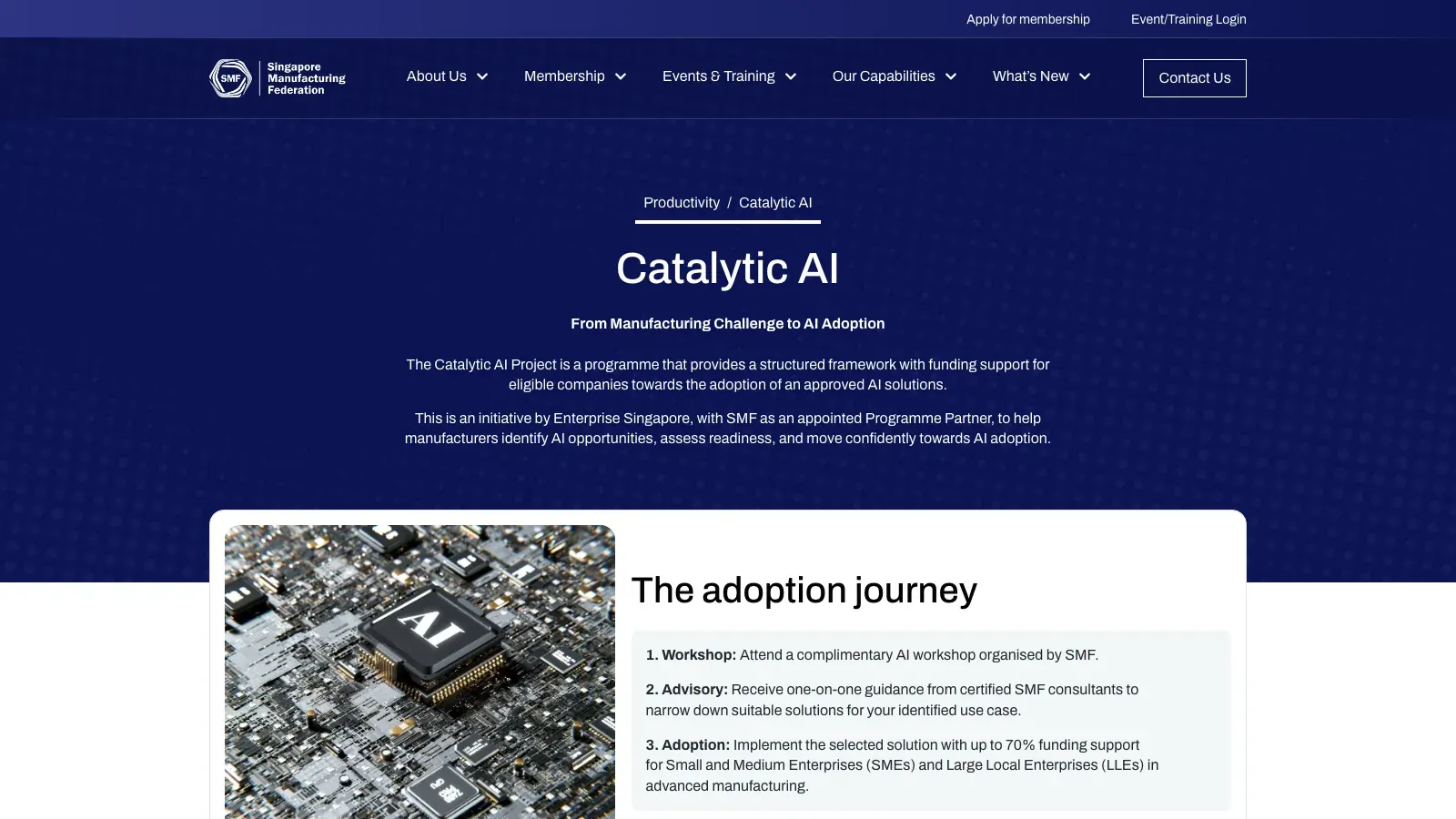
The Singapore Manufacturing Federation describes Catalytic AI as an Enterprise Singapore initiative, with SMF as an appointed programme partner, that helps manufacturers move from identifying AI opportunities through readiness assessment to adoption.
For an SME owner, the important number is on the official programme-partner page: the Singapore Manufacturing Federation says eligible SMEs and Large Local Enterprises in advanced manufacturing can receive up to 70% funding support to implement an approved solution. “Up to” is a ceiling, not a promise that every project or cost receives the full rate.
Key takeaways
- Adoption support can reach 70%: SMF states up to 70% funding support for SMEs and Large Local Enterprises implementing an approved solution in advanced manufacturing.
- The route starts before procurement: The published journey is a complimentary workshop, one-to-one advisory and then adoption, not buying a tool first and asking for reimbursement later.
- A narrow production problem is the best entry point: Bring one queue, delay or repeatable decision with a baseline, an owner and usable records.
What is Catalytic AI Singapore?
Catalytic AI is an Enterprise Singapore initiative delivered with programme partners including the Singapore Manufacturing Federation. Its purpose is to help manufacturers identify AI opportunities, assess readiness, narrow the choice of solutions and follow through into adoption.
SMF publishes a three-stage journey. First, a manufacturer attends a complimentary AI workshop. Second, certified SMF consultants provide one-to-one guidance to narrow the use case and suitable solutions. Third, the company implements the selected solution, subject to approval and the programme’s funding conditions.
Who can get up to 70% Catalytic AI support?
| Published programme detail | What it means | What to verify |
|---|---|---|
| Up to 70% funding support | A maximum support level, not an automatic rate | Approved percentage and eligible cost base |
| SMEs and Large Local Enterprises | Both groups are named on the SMF page | Your company’s eligibility under the programme |
| Approved AI solutions | The selected project must fit the programme route | Solution status and approval before purchase |
| Advanced manufacturing | The current page is sector-specific | Your activity and use case fall within scope |
SMF’s programme page names SMEs and Large Local Enterprises in advanced manufacturing. It lists electronics, energy and chemicals, healthcare manufacturing, precision engineering and transport engineering among the supported sectors.
The page describes support for an approved AI solution. It does not say that every applicant receives the maximum rate, that every vendor qualifies or that costs incurred before approval will be reimbursed. Treat the workshop and advisory stage as the place to verify company eligibility, solution approval, eligible cost categories, support rate, project dates and required evidence in writing.
Which manufacturing AI jobs could fit the programme?
SMF says the listed AI solutions are non-exhaustive and that new solutions are being evaluated and added. Choose by operational pain, not by which demo looks most impressive.
| Illustrative manufacturing job | Useful starting evidence | Human decision that remains |
|---|---|---|
| Product or component design | Past designs, specifications, constraints and review outcomes | Engineer approves the final design and safety decisions |
| Request-for-quotation processing | Incoming RFQs, item master, price rules, lead times and past quotes | Sales or operations approves exceptions and the final quote |
| Production scheduling | Orders, routings, machine capacity, changeovers and due dates | Planner resolves conflicts and releases the schedule |
| Predictive maintenance | Sensor history, failure records, work orders and downtime | Maintenance lead decides inspection and intervention |
The common pattern is a repeated decision backed by records. If the real bottleneck is missing job cards, inconsistent part numbers or approvals that happen only in private messages, clean up that path first. AI cannot recover context the business never records.
How should a manufacturer apply for Catalytic AI?
- 1. Pick one operational bottleneck. Name the queue or delay in one sentence: for example, “RFQs wait for someone to retype line items and find the latest lead time.”
- 2. Record the current baseline. Capture volume, elapsed time, rework, errors and the people involved using records you already have. Do not create a savings claim without evidence.
- 3. Gather representative inputs and exceptions. Bring real document types with sensitive details removed, plus the awkward cases that force a supervisor to step in.
- 4. Register interest in the SMF workshop. The official page provides a registration form and programme contact. Registration begins the conversation; it is not funding approval.
- 5. Use the advisory session to test fit. Ask which solution is approved, what data and system access it needs, which costs are eligible, and what outcome evidence the programme expects.
- 6. Wait for written scope and approval. Confirm the supported amount, project dates, deliverables, responsibilities and claims process before signing or spending.
What should you prepare before the workshop?
| Prepare | RFQ example | Why it matters |
|---|---|---|
| One workflow map | Inbox to extraction to costing to capacity check to approval | Shows where work waits and which systems are involved |
| A small representative sample | Normal RFQs plus revised, incomplete and unfamiliar parts | Tests the hard cases, not only the happy path |
| Decision rules | Valid item, minimum quantity, margin boundary and promised-date rule | Separates automation from judgement |
| Approval boundary | Sales lead approves price or date exceptions | Keeps commercial commitments with an accountable person |
| Baseline and success measure | Current turnaround, rework and missed fields | Makes the pilot measurable without invented ROI |
Consider a precision-engineering SME that receives RFQs as spreadsheets and PDFs. Staff retype part numbers, quantities and requested dates, check an item master, ask production about capacity and then prepare a quote. A sensible first project does not let AI set prices or promise delivery on its own. It prepares a structured draft, flags missing fields and routes exceptions to the right person.
If the workflow crosses email, spreadsheets, production records and customer messages, a customer operations AI agent can prepare the work across those handoffs while staff approve commercial or production exceptions.
What does the funding not remove?
Funding changes the project cost. It does not remove process ownership, data work or the need to compare the project with simpler options.
| Option | Best when | Main trade-off |
|---|---|---|
| Keep the manual process | Volume is low and exceptions dominate | No implementation project, but delays and retyping remain |
| Improve the spreadsheet or checklist | The rule is stable and one team owns the handoff | Fast and cheap, but still depends on manual updates |
| Hire another administrator | The work needs judgement across many unrelated cases | Adds flexible capacity, plus recurring hiring and management work |
| Adopt an approved AI solution | One repeated workflow has usable data and clear approvals | Can remove repeat work, but needs setup, testing, monitoring and an owner |
Enterprise Singapore’s Budget 2026 page separately says the Productivity Solutions Grant was expanded to cover more digital and AI-enabled solutions. Do not assume Catalytic AI, PSG and other support can be combined for the same cost. Ask the programme partner which route fits the project and whether support can be combined before building the budget.
The strongest application says “this production workflow creates a measurable delay, these records support it, these are the exceptions, and this person will own the outcome.” That is also the test for whether the project deserves management time even with funding.
What should a Singapore manufacturer do now?
Choose a clearly bounded production problem and write a one-page brief with the current workflow, sample records, baseline, approval boundary and desired result. Then register interest through SMF’s official Catalytic AI page and use the workshop to challenge the project, not to defend a tool already chosen.
Sources
- Singapore Manufacturing Federation: Catalytic AI
- Enterprise Singapore: Budget 2026
Common questions
- What is Catalytic AI Singapore?
- Catalytic AI is an Enterprise Singapore initiative that helps advanced manufacturers identify an AI use case, assess readiness, receive one-to-one advisory support and adopt an approved solution. The published SMF journey begins with a complimentary workshop and proceeds through advisory to adoption.
- How much Catalytic AI funding can a manufacturer receive?
- The Singapore Manufacturing Federation states that SMEs and Large Local Enterprises in advanced manufacturing can receive up to 70% funding support to implement an approved solution. The actual rate and eligible cost base must be confirmed for the specific project before spending.
- Which companies can apply for Catalytic AI?
- The official SMF page names SMEs and Large Local Enterprises in advanced manufacturing, including electronics, energy and chemicals, healthcare manufacturing, precision engineering and transport engineering. A programme partner should confirm the company and project eligibility.
- Which AI use cases are included in Catalytic AI?
- The Singapore Manufacturing Federation says the listed AI solutions are non-exhaustive and that new solutions are being evaluated and added. Manufacturers should take a clearly bounded operational problem to the workshop and confirm whether a suitable approved solution is available.
- How does a manufacturer start a Catalytic AI application?
- Start by documenting one operational bottleneck, its baseline, sample inputs, exceptions and human approval point. Then register interest for the complimentary workshop on the Singapore Manufacturing Federation’s Catalytic AI page and verify eligibility, approved solutions, eligible costs and project dates before committing.