Southeast Asia's AI Boom in Six Numbers (September 2026 Edition)

Every strategy conversation about AI in this region eventually reaches for the same handful of statistics, usually half-remembered. This page is the checkable version: six numbers that define where Southeast Asia’s AI economy stands, each with its source, each as verified in September 2026.
We will date each edition of this piece and never edit it silently, so a number you cite from here stays citable.
The six numbers
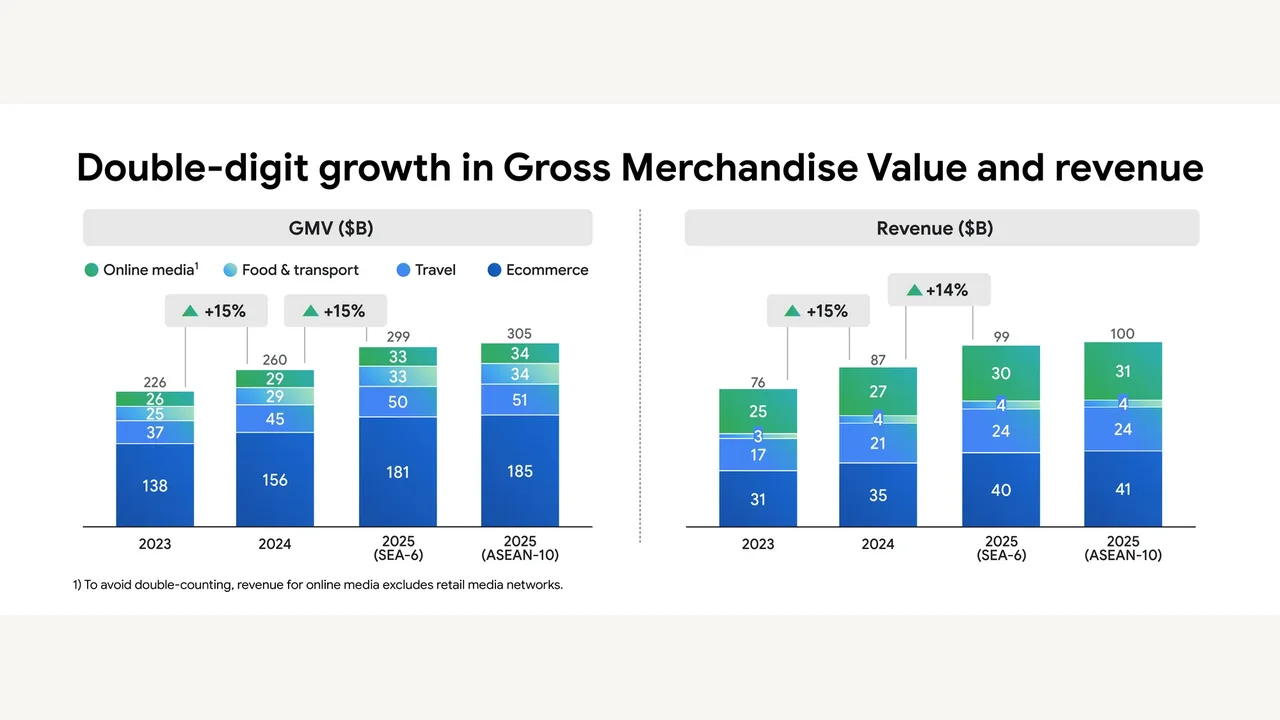
- US$300 billion: Southeast Asia’s digital economy GMV in 2025: 7.4 times its 2016 size. Source: e-Conomy SEA 2025, the tenth edition, by Google, Temasek and Bain, now covering ten markets.
- US$135 billion: Digital economy revenue, growing about 15 percent year on year alongside GMV. Same report.
- 3x: Consumer interest in AI in Southeast Asia versus the global average: the report’s headline argument that the region is a natural AI adopter, not a laggard.
- 14.5 percent: Singapore SMEs using AI in 2024, tripled from 4.2 percent in 2023, against 62.5 percent for larger firms. Source: IMDA Singapore Digital Economy Report. IMDA’s 2026 report has since put SME AI adoption at 23.4 percent for 2025, and larger firms at 70.4 percent.
- S$128.1 billion: Singapore’s digital economy: 18.6 percent of GDP, up from 14.9 percent in 2019. Same IMDA report. The 2026 edition has since revised the 2024 figure to S$136.5 billion (18.8 percent) and put 2025 at S$144.1 billion, 19.3 percent of GDP.
- #2 worldwide: Indonesia’s rank in WhatsApp Business app downloads (2022 data), with more than 100 million WhatsApp users: the single best predictor of what an AI interface must look like here.
What the numbers say together
Read as one sentence: a 300-billion-dollar economy whose consumers want AI three times more than the world average, whose small businesses have barely started adopting it, and whose commerce runs through chat. That market is already convinced. It is waiting for tools that fit.
The gap between the 62.5 percent of large firms and the 14.5 percent of SMEs is the opportunity line in every one of these reports. The macro numbers explain the direction; the micro numbers decide adoption one business at a time: in our own deployments, that looks like 20-plus hours of weekly admin down to under 30 minutes, one workflow at a time.
Sources
- Bain & Company: e-Conomy SEA 2025 report: ASEAN's digital economy poised to surpass $300 billion in GMV
- Google: ASEAN's $300 billion digital economy enters the AI reality
- Infocomm Media Development Authority (IMDA): Singapore's digital economy growth (press release, 6 October 2025)
- Infocomm Media Development Authority (IMDA): Singapore Digital Economy Report 2026
- Databoks (Katadata): Top 10 Countries with the Most WhatsApp Business Downloads: Is Indonesia on the List?
- CNN Indonesia: Jumlah Pengguna WhatsApp Tembus 3 Miliar, Berapa di Indonesia?
Common questions
- How big is Southeast Asia’s digital economy in 2025?
- Past 300 billion US dollars in GMV with about 135 billion in revenue, both growing around 15 percent a year: per e-Conomy SEA 2025 by Google, Temasek and Bain.
- How does Southeast Asia’s AI interest compare globally?
- Consumer interest in AI runs at three times the global average, according to e-Conomy SEA 2025.
- What share of Singapore SMEs use AI?
- 14.5 percent in 2024, tripled from 4.2 percent in 2023; larger firms were at 62.5 percent. Source: IMDA Singapore Digital Economy Report. IMDA’s 2026 report has since put SME adoption at 23.4 percent for 2025 (larger firms: 70.4 percent).
- Why does WhatsApp matter for AI adoption in the region?
- Because commerce here is conversational: Indonesia alone has more than 100 million WhatsApp users and ranked second worldwide for WhatsApp Business downloads (2022 data), so AI that works inside chat meets businesses where they already operate.