Southeast Asia's $300 Billion Digital Economy Runs on WhatsApp. Now the AI Does Too
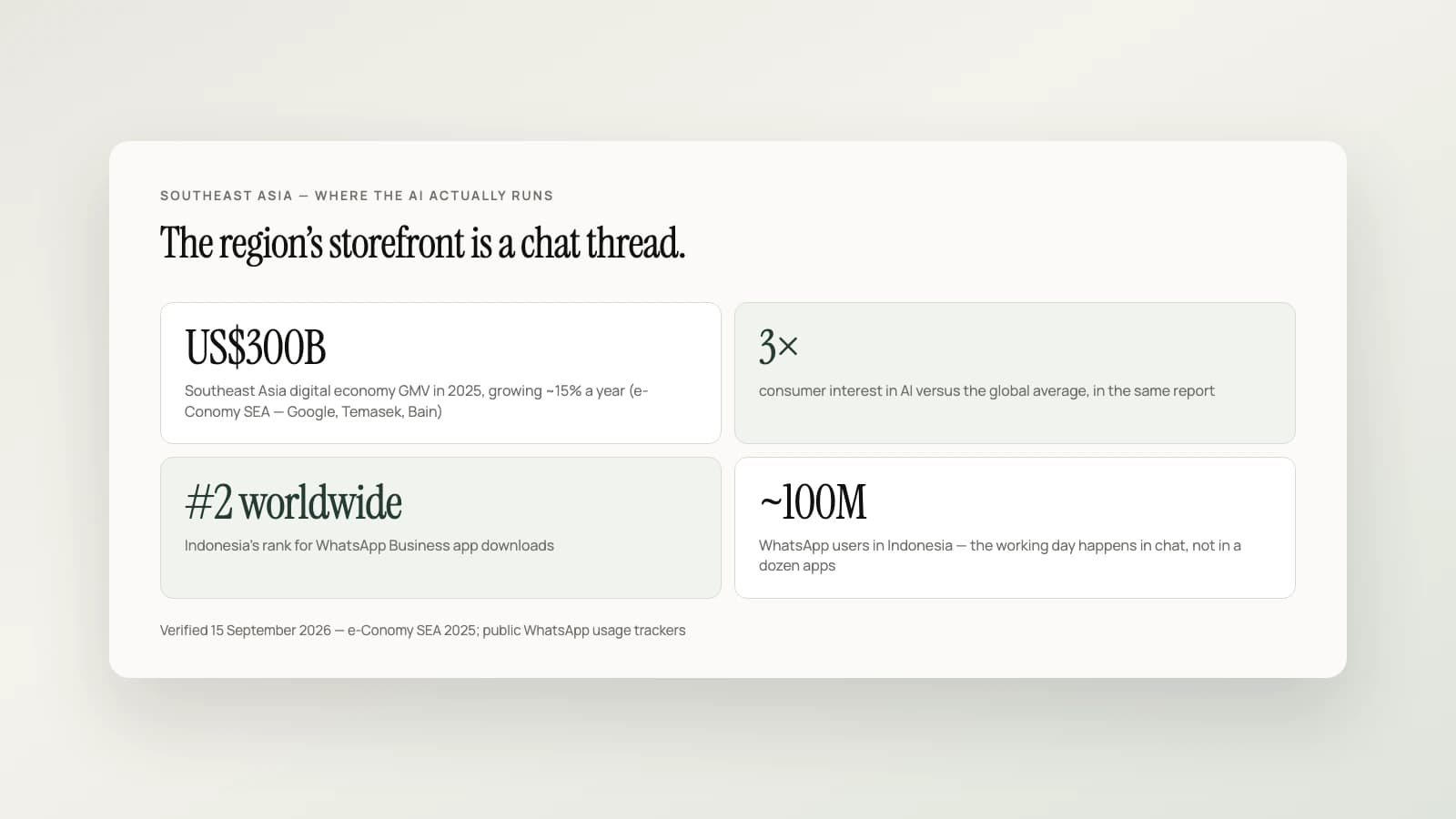
Southeast Asia's digital economy passed 300 billion US dollars in gross merchandise value in 2025, with revenue near 135 billion and both growing around 15 percent a year — the tenth e-Conomy SEA report, from Google, Temasek and Bain, calls this the region's shift from digital decade to AI reality. The same report measures consumer interest in AI here at three times the global average.
But the number that explains how AI will actually be adopted in this region is a different one: Indonesia ranks second in the world for WhatsApp Business app downloads, with roughly one hundred million WhatsApp users. In much of Southeast Asia, the storefront, the sales counter, the order book and the customer-service desk are all the same thing — a chat thread.
That has a consequence Silicon Valley keeps rediscovering late: here, the AI that wins is not the one with the best app. It is the one that answers inside the thread.
Commerce here is conversational, structurally
A typical Indonesian SME sale does not pass through a checkout page. A buyer messages, asks about stock, negotiates delivery, sends a payment screenshot, and expects a confirmation — all in one conversation. The order exists only as that thread. Which is why "digitalising" such a business with a web dashboard so often fails: it asks the business to move its counter.
AI changes the economics of the thread itself. The work inside it — answering the same product questions, reading payment proofs, booking the courier, chasing the delivery — is exactly the repetitive, rule-following work agents are good at. The interface was never the problem; the labour inside the interface was.
What an agent actually does inside WhatsApp
- Answers with the catalog, not about it: Stock, prices, variants — from live data, in the customer’s language, at midnight.
- Reads what customers actually send: Payment screenshots, photos of handwritten notes, voice messages — turned into structured records instead of retyped.
- Moves the order to done: Confirms payment, books delivery, sends tracking — with consequential steps gated behind human approval.
- Leaves numbers to code: Totals and confirmations follow deterministic logic computed in code, not text generated by a model. In our production deployments, daily order administration that took hours comes down to minutes of review.
The read for 2027
The e-Conomy numbers say the region is not waiting for anyone: 15 percent annual growth on a 300-billion-dollar base, with AI interest triple the global norm. The WhatsApp numbers say where that growth will be transacted.
Put together, they describe the next two years fairly precisely: the businesses that automate the thread — carefully, with approvals and guardrails — compound a speed advantage inside the exact channel their customers already use. The ones that wait for the region to adopt someone else’s app-first workflow will be waiting a while.
Common questions
- How big is Southeast Asia’s digital economy?
- Past 300 billion US dollars in gross merchandise value in 2025, with revenue around 135 billion — both growing roughly 15 percent a year, per the e-Conomy SEA 2025 report by Google, Temasek and Bain.
- How high is AI interest in Southeast Asia?
- Consumer interest in AI in Southeast Asia runs at three times the global average, according to the e-Conomy SEA 2025 report.
- How dominant is WhatsApp in Indonesia?
- Indonesia has roughly one hundred million WhatsApp users and ranks second worldwide for WhatsApp Business app downloads — for most SMEs the entire sales conversation, from enquiry to payment proof, happens in WhatsApp.
- What can an AI agent do inside WhatsApp for a business?
- Answer product questions from live catalog data, read payment screenshots and voice notes into structured records, confirm payments, book couriers and send tracking — with irreversible steps held for human approval. In production deployments, daily order admin drops from hours to minutes of review.
- Is WhatsApp automation allowed?
- Yes, through official WhatsApp Business channels and within their messaging policies — including consent rules for outbound contact. The compliant pattern is responding to customers who message you, not cold-blasting lists.